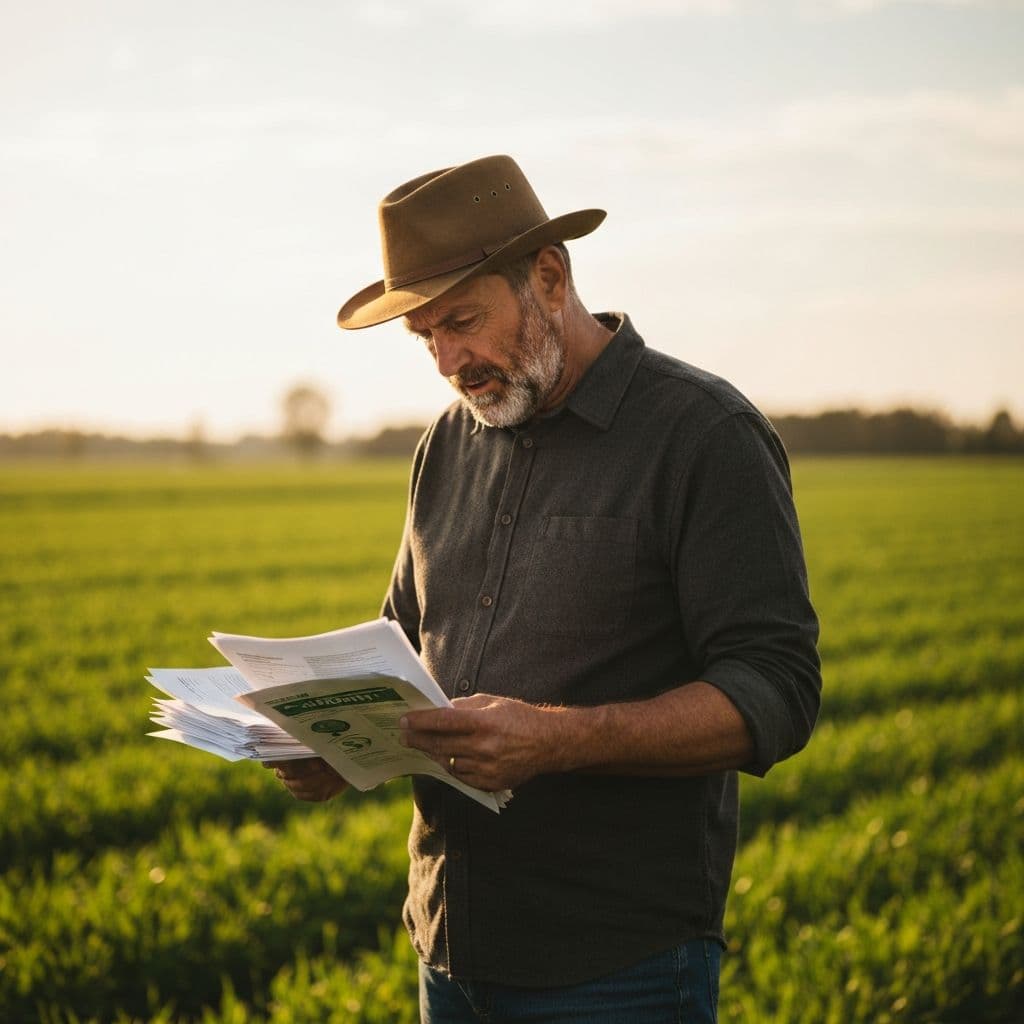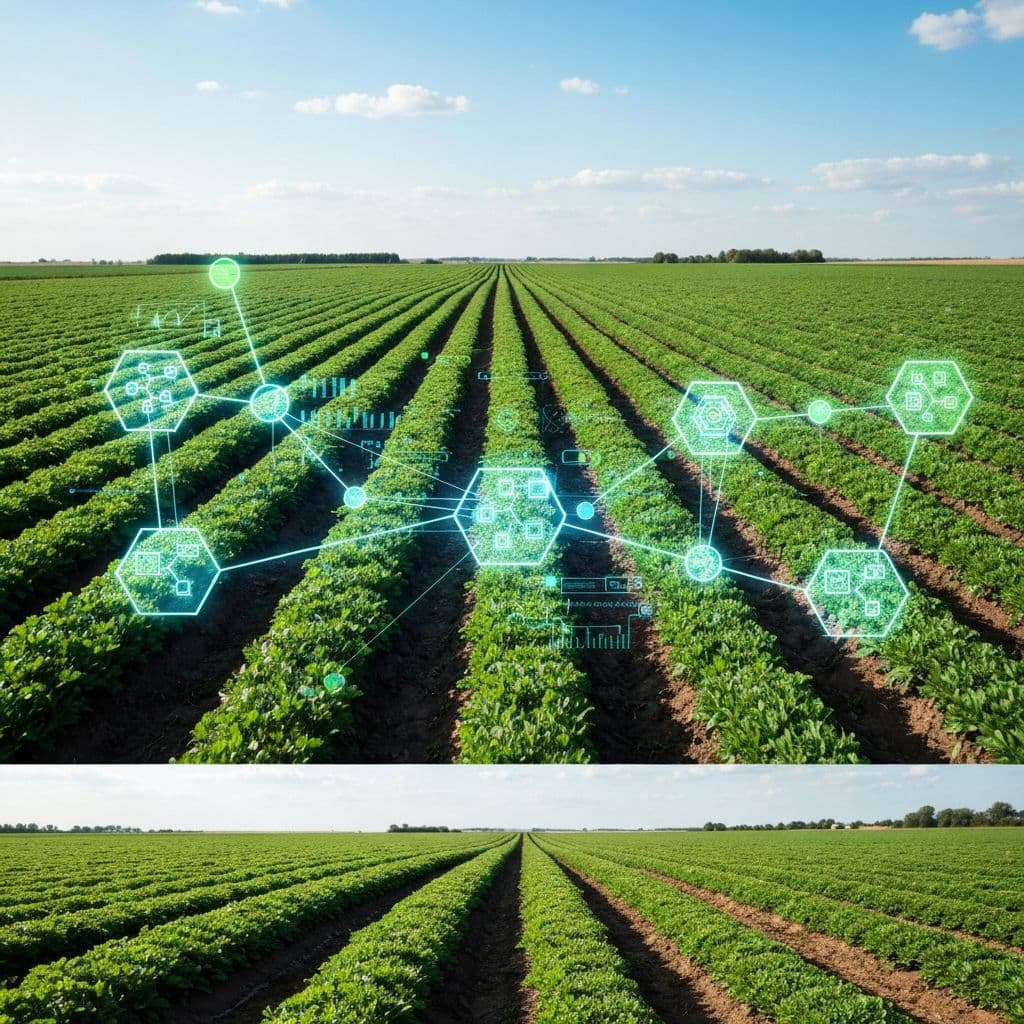
You do not need to understand how blockchain works in order to use it. Similarly, you do not need to know how email servers work to send an email.
If you are interested in understanding what happens when your farming practices are "blockchain verified," and why your customers may care, I will provide you a plain language description below.
A Plain Language Explanation of What Blockchain Means
Imagine a digital version of a notary public that never sleeps and never loses a record.
A traditional notary verifies a document and provides a credible record that states "the document existed at that point in time." A notary's seal serves as evidence of that document's existence and credibility, because there is no incentive for them to fabricate such a record.
Blockchain works similarly to a digital notary. When a farming practice is documented using blockchain, it produces a timestamped record that:
- Cannot be modified after the fact.
- Cannot be deleted by anyone, including the company providing the platform.
- Can be independently verified by anyone with access to the internet.
- Will remain permanently until the blockchain network is discontinued.
This is very different from a typical database, which can be modified, deleted, or retroactively altered by the person or entity controlling the database.
Why Blockchain Matters for Agriculture
There are serious problems related to credibility within traditional agriculture record keeping methods. Regardless of whether records are maintained using spreadsheets, farm management software applications, or even paper-based logbooks; records can potentially be modified by either the individual responsible for maintaining those records, or by the company responsible for managing the platform used to create and maintain those records.
Your customers are aware of these issues. Therefore, the skepticism generated by food labels is partially based upon distrust of the credibility of those labels.
Blockchain verification removes the question of trustworthiness regarding records. When a customer sees a blockchain verified badge next to documentation relating to your agricultural practices, it signifies:
- That the records were created at the time indicated.
- That no modifications have been made to those records since their creation.
- That those records can be independently verified without reliance on your honesty or the integrity of the company providing the platform to manage those records.
This represents a higher level of assurance than either an annual certification, self-reported data, or a claim made by your marketing department.
How It Works on Trazo (Step-by-Step)
Below is an example of how you would document and complete a production:
Step 1: Document the Event. For example, you apply organic fertilizer. You input the specifics — type, quantity, date — and you also have the option to attach a photo.
Step 2: Generate a Record. Trazo saves the event details into Trazo's database with all of the information you entered.
Step 3: Close the Production. When you finalize a production (at the conclusion of harvest) and have the blockchain add-on active ($15/month), Trazo automatically generates a cryptographic "fingerprint" (known as a hash) of the entire production record — all events, all details — and submits it to the Polygon blockchain network. The hash is similar to a digital seal — if anyone had modified even a single character of the original data, the resulting fingerprint would not match.
Step 4: The Transaction is Confirmed. Polygon's validators confirm the transaction. This usually occurs in a matter of seconds. Upon confirmation, the record becomes permanent and publicly available. All of the events in the production become forever locked.
Step 5: Your Customers See Verification. When someone scans your QR code and views your history of farming practices, your customer will see a verification badge confirming that the production record has an immutable blockchain record. If your customer wants to dig further, he/she can view the actual transaction on Polygonscan — a public blockchain explorer.
With the blockchain add-on active, everything is automatic. You simply finalize the production, and the recording is handled in the background.
Why Polygon?
Not all blockchains are equal. Trazo utilizes the Polygon network for a number of practical reasons:
- Speed: Transactions confirm in seconds, rather than minutes
- Cost: The cost of transaction fees is pennies per transaction
- Environmental Impact: Polygon utilizes a proof-of-stake validation system and therefore consumes little power — no large-scale mining operations exist
- Existing Infrastructure: Polygon handles tens of millions of transactions each day for major corporations
- Transparency: Anyone can verify records on Polygonscan.com
For farmers, the ultimate goal is simple: it is fast, inexpensive, and environmentally friendly.
Blockchain vs. Traditional Certification
| Aspect | Traditional Certification | Blockchain Verification |
|---|---|---|
| Frequency | Annual audit | Per production, when closed |
| Cost | $500-5,000+ per year | $15/month add-on |
| Tampering | Records can be altered between audits | Records are immutable |
| Consumer access | Label on package | Detailed, scannable journey |
| Timeliness | Reflects practices from months ago | Reflects current production |
| Independence | Auditor employed by certification body | Public blockchain, verifiable by anyone |
Blockchain validation is not going to replace certification when it is required. It does, however, provide a level of real time, tamper proof validation that certification cannot provide.
Transparency from the Consumer's Viewpoint
To the consumer, blockchain validation is easy to understand. All the consumer has to do is scan a QR Code and see:
- a transparency score which shows the extent to which you have properly documented your farming process
- the history of your farming process (from planting to harvesting) as recorded by a series of events
- a badge that indicates that your documentation has been validated using blockchain technology
- optionally, a link to the blockchain explorer for those who want to verify your records independently.
While most consumers will likely never click through to the blockchain explorer, simply having this ability to verify your documentation creates a high level of genuine trust with your customer base.
Getting Started
Blockchain validation is provided by Trazo as an additional service. Once activated, there is no further learning, configuration, or management needed. After each closed production, your documentation is automatically checked and stored in the blockchain in the background.
All you have to do is document your practices as completely and as consistently as possible, and the blockchain will take care of the validation for you.
Add blockchain recording to your farm documentation. When you close a production with the blockchain add-on active, your entire documentation is automatically fingerprinted and recorded to the Polygon blockchain — no technical setup required on your end.
Sources
Ready to build transparency into your farm?
Start documenting your farming practices and earn consumer trust with Trazo.
Start Free Trial